Introduction
In the world of pharmaceutical formulation, few decisions carry as much weight as the choice of superdisintegrant. This single excipient determines how quickly a tablet breaks apart, how rapidly the drug becomes available for absorption, and ultimately, how effectively the medication performs its therapeutic function.
The global superdisintegrants market was estimated at US$508.1 million in 2025 and is projected to reach US$675.1 million by 2032, growing at a CAGR of 4.1%. This growth is driven by the increasing demand for fast-acting and patient-friendly drug delivery systems, particularly orally disintegrating tablets (ODTs).
Yet despite the critical importance of superdisintegrants, many formulators rely on a single, familiar option without fully understanding the distinctions between available choices. This approach can compromise formulation performance, increase costs, and delay product development.
At Prachin Pharma, we manufacture all three major superdisintegrants—Croscarmellose Sodium (CCS), Sodium Starch Glycolate (SSG), and Calcium Carboxymethyl Cellulose (Calcium CMC). This unique position gives us an unparalleled understanding of each material's strengths, limitations, and optimal applications.
This guide provides the technical insight you need to make informed decisions about superdisintegrant selection.
Understanding Superdisintegrant Mechanisms
Before comparing specific materials, it is essential to understand the fundamental mechanisms by which superdisintegrants work.
Swelling
When a superdisintegrant absorbs water, it expands. This swelling generates internal pressure within the tablet, causing it to fracture and break apart. Swelling is the primary mechanism for most superdisintegrants, but the rate and extent of swelling vary significantly between materials.
Wicking
Some superdisintegrants facilitate rapid water penetration into the tablet matrix through capillary action. This wicking action accelerates the overall disintegration process by ensuring that water reaches all parts of the tablet simultaneously.
Strain Recovery
When tablets are compressed, the excipient particles are deformed. Upon contact with water, some superdisintegrants "recover" their original shape, generating additional disruptive forces that aid disintegration.
Each superdisintegrant employs these mechanisms to different degrees, and understanding these differences is key to optimal selection.
Croscarmellose Sodium (CCS): The Rapid Disintegration Specialist
Mechanism of Action
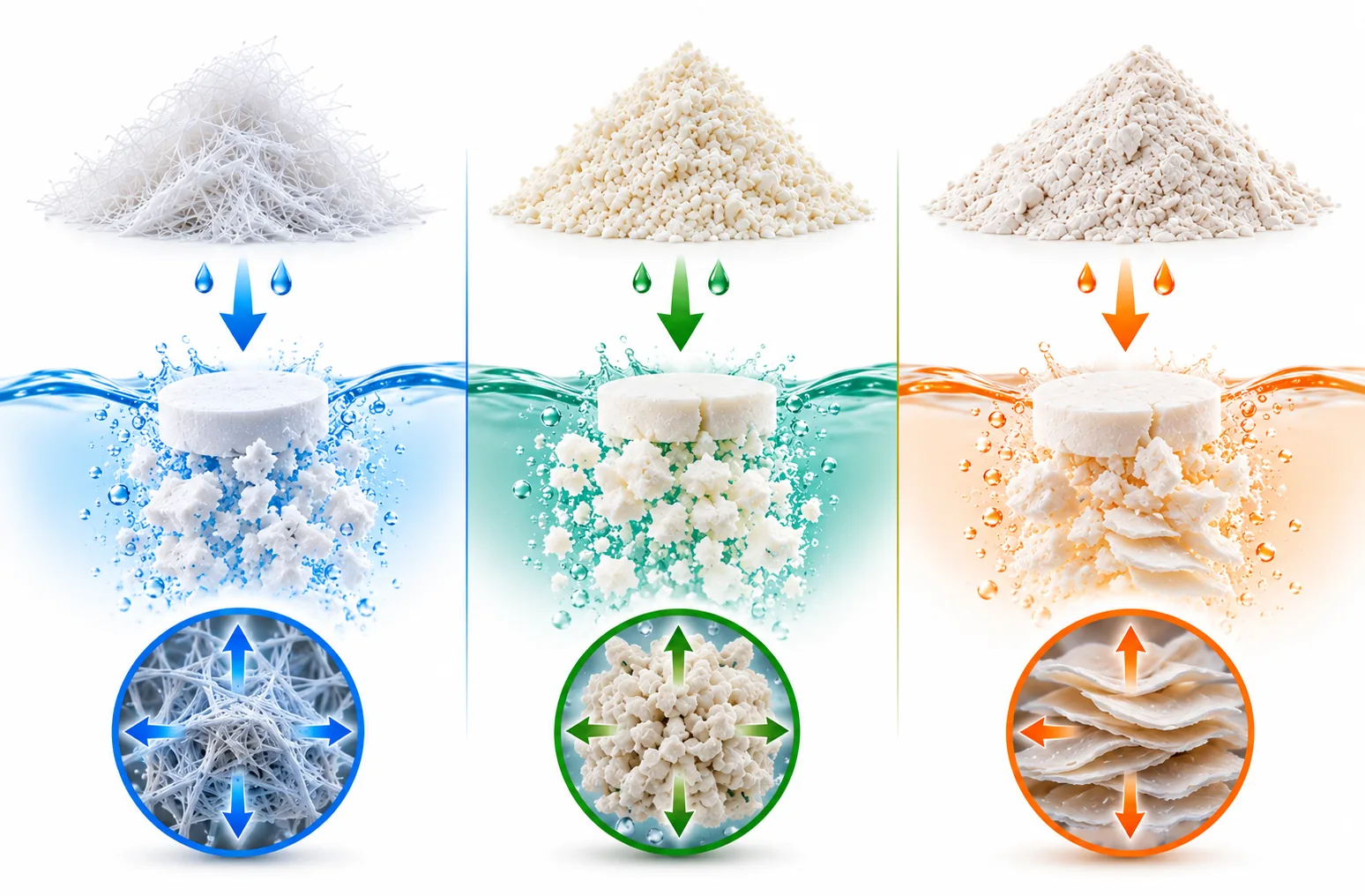
Croscarmellose Sodium is a cross-linked polymer of carboxymethylcellulose sodium. Its cross-linked structure prevents dissolution while enabling rapid water uptake and swelling. The swelling capacity of CCS is exceptional—it can absorb water and swell to many times its original volume within seconds.
Key Performance Characteristics
- Rapid disintegration timings: CCS consistently delivers the fastest disintegration times among commonly used superdisintegrants
- Superior wicking action: The fibrous structure of CCS facilitates rapid water penetration
- Excellent compatibility: CCS performs well across a wide range of APIs and formulation types
- Low use levels: Effective at concentrations of 0.5-5.0% by weight
Optimal Applications
CCS is particularly well-suited for:
- Orally disintegrating tablets requiring disintegration in under 30 seconds
- Fast-release formulations where rapid drug absorption is critical
- High-drug-load formulations where excipient levels must be minimized
- Capsule formulations requiring rapid dissolution
Market Context
The global Croscarmellose Sodium market is valued at approximately USD 1.5 billion in 2025 and is projected to reach USD 2.8 billion by 2035, growing at a CAGR of 6.2%. This growth reflects the increasing adoption of CCS across pharmaceutical, food processing, and cosmetic applications.
Sodium Starch Glycolate (SSG): The Swelling Powerhouse
Mechanism of Action
Sodium Starch Glycolate is a cross-linked starch derivative. Its mechanism relies primarily on rapid and extensive swelling upon contact with water. The degree of substitution—the number of carboxymethyl groups per glucose unit—is critical to performance, with optimized grades delivering superior disintegration.
Key Performance Characteristics
- Exceptional swelling capacity: SSG can swell to 200-300 times its original volume
- Cost-effective: Generally lower cost than other superdisintegrants
- Broad pharmacopeial alignment: SSG is recognized by all major pharmacopeias, reducing documentation friction
- Effective at low use levels: Typically 2-8% by weight
Optimal Applications
SSG is particularly well-suited for:
- Wet granulation formulations where the superdisintegrant is added extragranularly
- Formulations requiring rapid disintegration with cost sensitivity
- Generic drug products where pharmacopeial recognition is important
Market Context
The sodium starch glycolate market is expected to grow from USD 86.70 million in 2025 to USD 125.30 million by 2031, at a CAGR of 6.44%. The market benefits directly from rising generic pharmaceutical output and the steady expansion of nutraceutical tablets and capsules.
Calcium CMC: The Multifunctional Alternative
Mechanism of Action
Calcium Carboxymethyl Cellulose (Calcium CMC) functions through a combination of swelling, wicking, and binding mechanisms. Its unique calcium cross-linking provides structural integrity while enabling water uptake and disintegration.
Key Performance Characteristics
- Multifunctional: Acts as binder, diluent, disintegrant, suspension aid, and tackifier
- Controlled water uptake: The calcium cross-linking moderates swelling, providing more controlled disintegration
- Excellent suspension properties: Particularly valuable in liquid and semi-solid formulations
- Food-grade applications: Widely used as thickener and stabilizer in food products
Optimal Applications
Calcium CMC is particularly well-suited for:
- Suspension formulations requiring stability
- Food and nutraceutical applications
- Cosmetics and personal care products
- Formulations where multifunctionality is valued
Application Across Industries
Beyond pharmaceuticals, Calcium CMC finds extensive use as a thickener, stabilizer, gellant, and suspending agent in food applications, improving processing efficiency, extending shelf-life, and enhancing mouthfeel. Its versatility across industries makes it a valuable option for manufacturers serving multiple markets.
Comparative Decision Matrix
| Parameter | Croscarmellose Sodium (CCS) | Sodium Starch Glycolate (SSG) | Calcium CMC |
|---|---|---|---|
| Primary Mechanism | Swelling + Wicking | Swelling | Swelling + Binding |
| Disintegration Speed | Fastest | Fast | Moderate |
| Use Level | 0.5-5.0% | 2-8% | 1-5% |
| Compatibility | Excellent | Good | Very Good |
| Cost | Moderate | Lower | Moderate |
| Multifunctionality | Limited | Limited | Extensive |
| Best For | ODTs, Fast Release | Generic Products, Cost Sensitivity | Suspensions, Foods, Cosmetics |
The Quality Factor
Regardless of which superdisintegrant you choose, quality matters. The performance of superdisintegrants depends critically on manufacturing consistency—particle size distribution, degree of substitution, moisture content, and other critical quality attributes must be precisely controlled.
Prachin Pharma manufactures all three superdisintegrants to the highest pharmacopeial standards. Our GMP, ISO 9001, ISO 14001, ISO 22000, HALAL, KOSHER, and EXCiPACT certifications reflect our commitment to quality. Our manufacturing expertise, honed over 35+ years, ensures that every batch delivers consistent performance.
Moreover, as an Indian manufacturer, we offer distinct advantages over imported alternatives:
- Reduced supply chain risks
- Shorter lead times
- Competitive pricing without quality compromise
- Direct technical support from our formulation experts
Conclusion
Choosing the right superdisintegrant is not a one-size-fits-all decision. Each material—Croscarmellose Sodium, Sodium Starch Glycolate, and Calcium CMC—offers distinct advantages that make it optimal for specific applications.
CCS delivers the fastest disintegration, making it the preferred choice for ODTs and rapid-release formulations. SSG offers exceptional swelling at a competitive cost, ideal for generic products and cost-sensitive applications. Calcium CMC provides multifunctional performance across pharmaceuticals, foods, and cosmetics.
With Prachin Pharma, you do not have to choose a single supplier for a single superdisintegrant. We manufacture all three, giving you access to the full spectrum of superdisintegrant technology from a single, trusted source.
Need help selecting the right superdisintegrant for your formulation? Contact Prachin Pharma's technical team for expert guidance. Our formulation scientists are available to discuss your specific requirements and recommend the optimal solution.
Reviewed by Prachin Pharmachem Technical Team
This article is intended for procurement, QA, formulation and technical evaluation teams. Product suitability should be confirmed through formulation trials, specification review and regulatory assessment before commercial use.